What if one of the biggest opportunities in workplace safety isn’t another procedure?
17 September 2026
Make the Safe Thing the Easy Thing: Why Good Safety Design Removes Friction
There’s an idea I keep coming back to when thinking about workplace safety:
If we want people to make safer choices, we should make those choices easier.
It sounds simple.
But think about how often the opposite happens.
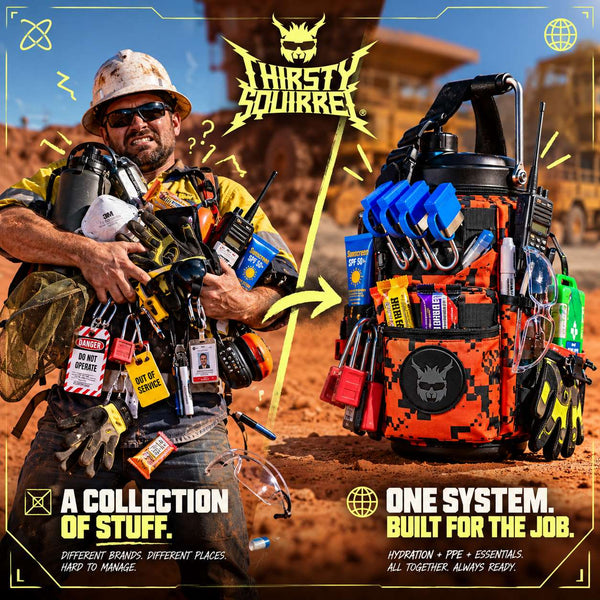
The sunscreen is back in the crib room.
The spare safety glasses are in the ute.
The hydration powder is somewhere in a lunch bag.
The worker brought a small bottle, finished it hours ago and now has to find somewhere to refill it.
Their keys, phone, wallet and other personal items are spread between pockets, bags, vehicles and lockers.
None of these things, individually, sounds like a major safety issue.
But collectively they create something that receives far less attention than it probably should:
friction.
And friction influences behaviour.
That is an important conversation for workplace health and safety — particularly as we approach another Australian summer and National Safe Work Month 2026.
This year's theme is “Safe work is for life.”
Safe Work Australia says the theme recognises that WHS is about more than preventing harm in the moment. It is about protecting workers' lives, health and future — including their ability to live fully outside of work.
That is a powerful way to think about safety.
Because ultimately, safety isn't about paperwork.
It's about people.
And sometimes improving safety means looking at the small things that influence what people actually do every day.
The gap between knowing and doing
Most experienced workers know they should stay hydrated.
They know they should wear their PPE.
They know they should apply sunscreen.
They know they should take breaks when required.
They know where the procedures are.
Knowledge is important — but knowledge doesn't automatically translate into behaviour.
Human factors research has recognised this problem for years.
The UK's Health and Safety Executive describes human factors as involving the interaction between the job, the individual and the organisation, including the way equipment, tasks, workload, procedures and the working environment are designed.
Importantly, HSE notes that when jobs, equipment or environments are poorly designed, people often adapt their behaviour to compensate — sometimes with consequences for health and safety.
That distinction matters.
Instead of always asking:
“Why didn't the worker follow the process?”
Perhaps we should sometimes ask:
“How easy did we make it for them to follow the process?”
Work as imagined versus work as done
Anyone who has spent time in operational environments knows there can be a difference between how a task looks in a procedure and how that task actually gets completed at 2:30 in the afternoon.
Researchers sometimes refer to this as “work as imagined” versus “work as done.”
A 2024 study in the International Journal of Industrial Ergonomics examined why workers deviate from procedures. Researchers found that frontline users reported more procedure deviations than administrators estimated, and that the reasons included environmental, organisational, task and individual factors. The researchers also noted the importance of procedures being practical, efficient and suited to the work being performed.
Another 2024 study in the Journal of Safety Research similarly argued that safety is embedded in everyday workplace practices and interactions, rather than existing solely through standardised management systems.
That's an important distinction.
You can have an excellent procedure that says:
Workers must remain adequately hydrated.
But what does hydration actually look like at the sharp end?
Where is the water?
How much can the worker carry?
How frequently can they access it?
Is it cool?
Does accessing it mean stopping the task and travelling somewhere else?
Is refilling convenient?
Does the worker have electrolytes available when appropriate?
These practical details matter.
Friction changes behaviour
Behavioural science gives us another useful way of looking at this.
A 2024 Safety Science study tested behavioural “nudges” in a steel plant.
One intervention placed gas-hazard reminders directly on workers' jackets to encourage gas-detector use. Another used visual hand cues to encourage workers to use handrails.
The researchers reported improved safety behaviour and concluded that relatively simple behavioural interventions can form part of a broader safety strategy.
That's fascinating because the underlying concept isn't complicated.
The safe behaviour was brought closer to the moment when the decision occurred.
The environment helped prompt the behaviour.
Instead of relying entirely on someone remembering what they had been told hours, days or months earlier, the system supported the desired behaviour.
That's essentially what reducing friction is about.
Put the thing people need where they need it.
Make the desired behaviour convenient.
Reduce unnecessary steps.
Design around how people actually work.
Hydration is a perfect example
In Western Australia, this becomes particularly relevant when talking about heat.
WorkSafe WA states that hot workplaces are common across the state and that heat stress can range from discomfort through to life-threatening heat illness.
Its guidance says workers should be encouraged to begin shifts adequately hydrated, and that clean drinking water must be readily accessible. WorkSafe also recommends replacing lost fluids during hot work and identifies hydration as an important part of preventing heat illness.
Safe Work Australia's heat-risk checklist similarly asks employers to consider whether workers have cool drinking water or electrolyte drinks on hand, alongside factors including humidity, workload, PPE, acclimatisation, breaks and the availability of cooler recovery areas.
Notice the wording:
On hand.
Readily accessible.
Accessibility matters.
The scale of heat exposure in Australian workplaces
The latest national data gives this issue even more context.
Safe Work Australia's Australian Worker Exposure Survey 2026 surveyed more than 6,600 Australian workers and estimated that approximately 10.2 million workers — 68% of the workforce — were exposed to at least one workplace hazard agent.
Heat exposure was particularly significant.
The survey estimated that:
-
29.9% of Australian workers — approximately 4.49 million people — are exposed to heat at work.
-
In mining, 64.3% of workers were estimated to be exposed to heat at work.
-
34% of Australian workers — approximately 4.87 million people — were exposed to solar UV.
-
Among workers exposed to heat, around 64.8% were also exposed to solar UV.
The exposure picture is particularly relevant for the industries Thirsty Squirrel was originally built around.
Safe Work Australia's data found that workers exposed to five or more hazard agents were particularly common in:
Construction — 68.2%
Mining — 60.0%
And among occupational groups:
Construction trades workers — 82.1%
Construction and mining labourers — 81.4%.
That doesn't mean carrying a bigger water bottle magically solves heat exposure.
It doesn't.
Heat needs to be managed as a workplace risk using appropriate risk assessment and controls — including work planning, shade, rest, job rotation where appropriate, access to cooling, acclimatisation, supervision, hydration and other measures relevant to the circumstances.
But it does highlight why practical access to hydration and personal protective essentials matters.
When heat affects more than comfort
Heat isn't simply uncomfortable.
Research continues to examine its relationship with physical and cognitive performance.
A study of outdoor workers published in 2024 examined heat stress, hydration and reaction time. Researchers found that more than half of the workers studied experienced sweat rates greater than 1.2 litres per hour under high environmental temperatures, and increasing heat stress was associated with increased reaction time.
An Australian study examining worker health data across several decades has also found that high temperatures were associated with increased workers' compensation claims, particularly among people performing manual outdoor work.
And this isn't theoretical in Western Australia.
In March 2025, WorkSafe WA republished a significant incident report concerning a field technician who collapsed while conducting exploration work in the Pilbara.
The technician had been walking considerable distances in temperatures reaching approximately 37°C.
The investigation identified inadequate hydration and management of heat exposure among the direct causes and highlighted deficiencies including heat-management procedures, task-based risk assessment and access to suitable cooling.
It is a sobering reminder that hydration must sit within a much broader heat-management system.
Safety needs systems — but systems need to work for humans
None of this is an argument against procedures, training, supervision or formal safety systems.
They're essential.
It's an argument for adding another question when we design those systems:
How will a human being actually interact with this control?
If something is uncomfortable, inaccessible, difficult, inconvenient or constantly getting in the way of the job, there is a greater risk that people will find another way.
That's human behaviour.
Rather than pretending that behaviour doesn't exist, good safety design should anticipate it.
We can see similar thinking in research around PPE.
A 2024 Australian study looking at N95/P2 respirator use found differences between prescribed respiratory protection and what some healthcare workers were actually wearing, while discomfort and interference with duties were also reported.
PPE effectiveness ultimately depends not simply on issuing equipment, but on workers having suitable equipment and using it correctly.
Again:
Work as imagined versus work as done.
What does this have to do with Thirsty Squirrel?
A lot, actually.
Thirsty Squirrel started with a simple question:
Can we make everyday safety and hydration easier?
The 3.8L Thirsty Squirrel bottle gives workers significant hydration capacity in one container.
Then came the covers.
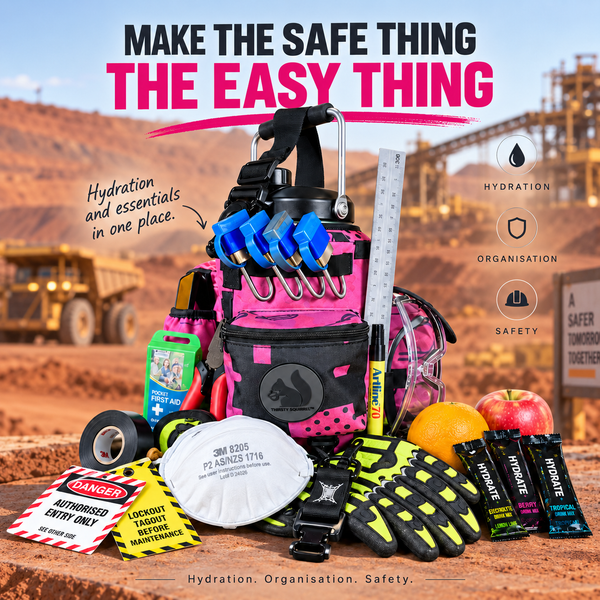
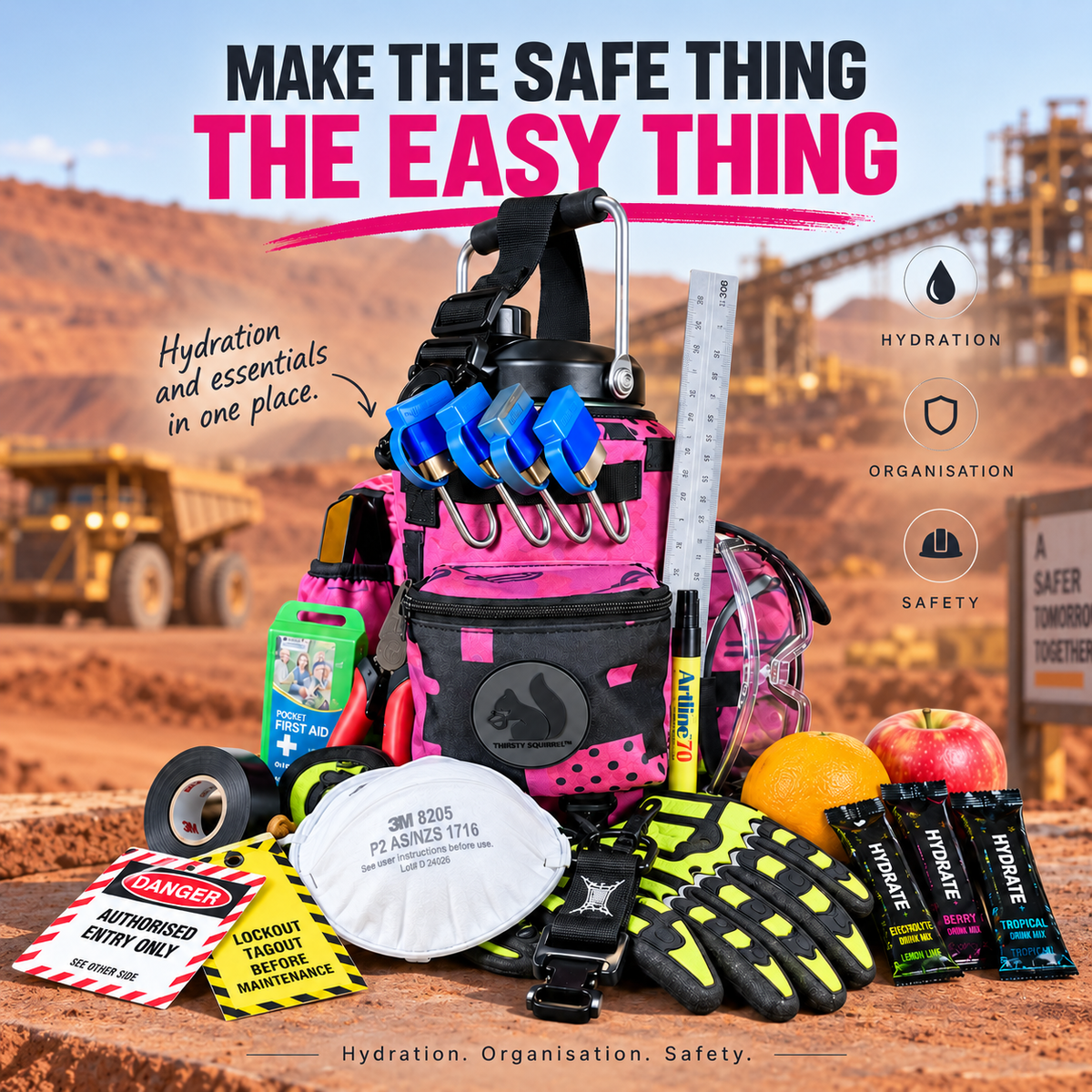
The OG Cover creates storage around the bottle for commonly used items.
The MOLLE Cover takes that further, providing a configurable platform that allows users to organise and carry gear around their hydration system.
Depending on the workplace, task and site requirements, that could include things such as:
-
sunscreen
-
safety glasses
-
gloves
-
lip balm
-
hydration products
-
hearing protection
-
keys
-
identification
-
small personal items
-
other approved workplace essentials.
The concept is pretty simple.
Keep hydration and regularly used essentials together.
Instead of water being somewhere, sunscreen somewhere else, glasses back in the ute and personal gear buried in a bag, give people the ability to organise the things they regularly need around something they already carry.
Does that replace a workplace's risk-management obligations?
Absolutely not.
Does carrying 3.8 litres mean every worker automatically needs to drink 3.8 litres?
No. Individual hydration requirements vary considerably with workload, environment, duration, acclimatisation, diet, individual characteristics and other factors.
And no piece of equipment replaces properly designed heat controls.
The objective is much simpler:
reduce friction.
The same thinking extends beyond the workplace
This is also where the Thirsty Squirrel concept has evolved.
Health and safety shouldn't stop when someone clocks off.
The 2026 National Safe Work Month theme captures this particularly well.
Safe Work Australia describes “Safe work is for life” as recognising that workplace health and safety is about protecting people's lives, health and futures, rather than simply preventing an immediate injury.
We agree.
People train.
They run.
They play sport.
They fish.
They camp.
They go to the beach.
They spend weekends outside.
They try to improve their health.
They try to stay active.
Which means the same principle applies beyond work.
Make looking after yourself easier.
Take the gym
You arrive carrying a bottle, keys, wallet, phone, earbuds, lifting straps and whatever else you've brought.
You put some in a locker.
Some stays beside the machine.
The bottle gets left near another piece of equipment.
Then you spend the session walking between your gear and your workout.
Why?
A hydration system with integrated storage makes sense there too.
Your water comes with you.
Your valuables come with you.
Your small training accessories come with you.
You don't need a mining site for organisation and hydration to be useful.
The principle is exactly the same:
Put what you need where you need it.
Health and safety is bigger than compliance
This may ultimately be the bigger conversation.
For a long time, workplace safety has sometimes been framed primarily around compliance.
Did we conduct the pre-start?
Did they sign the SWMS?
Did we complete the inspection?
Were they wearing PPE?
Were the records completed?
Those things matter.
But compliance is the minimum.
Good safety should also consider health, wellbeing, human behaviour and the design of work itself.
And the latest Australian data shows why that broader perspective matters.
Safe Work Australia reports that in 2024, 188 Australian workers died from traumatic work-related injuries, while preliminary data recorded 146,700 serious workers' compensation claims in 2023–24 — more than 400 serious claims every day.
Behind every statistic is a person who has a life outside the workplace.
A family.
Friends.
Goals.
Sport.
Hobbies.
Plans for the weekend.
Something they're training for.
Something they're building.
Something they're looking forward to.
That's why the words Safe Work is for Life matter.
Maybe innovation doesn't always need to be complicated
When we talk about safety innovation, it's easy to immediately think about artificial intelligence, sensors, automation, wearables and advanced technology.
Those things absolutely have a role.
But sometimes innovation is much simpler.
Sometimes it's noticing an everyday problem and asking:
Why do we still do it like this?
Why does essential gear need to be scattered everywhere?
Why do people carry tiny water bottles into environments where hydration is important?
Why do we design controls that are technically available but practically inconvenient?
Why aren't we thinking more about how workers actually interact with the equipment we're asking them to use?
Sometimes a small design change can influence thousands of everyday decisions.
Make the safe thing the easy thing
That's the philosophy we're building Thirsty Squirrel around.
We're not trying to replace safety systems.
We're trying to complement them.
We're trying to take some of the everyday basics — hydration, organisation and access to essential gear — and make them simpler.
Because when something is easier to carry, it's more likely to come with you.
When something is easier to access, you're more likely to use it.
When hydration is sitting beside you, you're more likely to think about drinking.
When sunscreen is attached to the gear you already carry, there is one less reason not to apply it.
When your essentials are organised in one place, there's less running around trying to find them.
None of those things alone creates a safe workplace.
But good safety has never been about one thing.
It is thousands of decisions, systems, behaviours and interactions working together.
And if we can make even some of those decisions easier?
That's worth doing.
Hydration. Organisation. Safety. Health. Wellbeing.
At work, at the gym and wherever life takes you.
Thirsty Squirrel.
Make the safe thing the easy thing.
Sources and further reading
This article draws on current guidance and research from Safe Work Australia, WorkSafe Western Australia, the UK Health and Safety Executive and recent peer-reviewed research published in Safety Science, the Journal of Safety Research, the International Journal of Industrial Ergonomics and occupational-health literature. Key sources include Safe Work Australia's 2026 Australian Worker Exposure Survey, its 2026 National Safe Work Month materials, current heat-risk guidance from Safe Work Australia and WorkSafe WA, and recent research into heat exposure, human factors and behavioural approaches to workplace safety.

Shop the gear from this guide
Browse the Thirsty Squirrel products mentioned in this article.