Putting Your Seatbelt On After the Crash
14 October 2026
Why making safety equipment readily accessible might be one of the simplest ways to improve workplace safety.
Imagine getting into your car, driving down the highway and deciding you'll put your seatbelt on at the next set of traffic lights.
Sounds ridiculous, doesn't it?
Nobody plans to have an accident, and nobody knows exactly when one might happen. That's why we put our seatbelts on before we start driving, not when we think the risk is getting a little too high.
Yet across mining, construction and industrial workplaces, we regularly see the workplace equivalent of putting on a seatbelt after the crash.
"I'll grab some safety glasses at smoko."
"My earplugs are in the ute. I'll get them when Davo gets back."
"I've run out of sunscreen. I'll put some on when I get back to camp."
"It's only a quick job. I'll be right."
Sound familiar?
The problem is that workplace hazards don't operate on our schedules.
The flying particle doesn't wait for smoko. The noise doesn't stop damaging your hearing because Davo has the ute. And UV exposure doesn't disappear because your sunscreen is back at camp.
By the time you need that protection, it may already be too late.
Is It Really a Compliance Problem, or Have We Made Safety Inconvenient?
When workers don't wear their PPE, the conversation often turns to individual behaviour.
They're complacent. They're not following instructions. They know better. They need another toolbox talk.
Sometimes that's fair. Workers have responsibilities, and deliberately ignoring established safety requirements isn't acceptable.
But before we jump straight to blaming the individual, perhaps we should ask a different question.
Have we actually made it easy for people to do the right thing?
Consider a worker who needs a pair of safety glasses.
They've been issued the glasses. They've completed their induction. They know the rules. They've even signed the PPE procedure.
But their glasses are sitting in a ute 300 metres away, and they've just arrived at the job.
The correct decision is obvious: don't start until the required protection is available.
But we've also introduced an unnecessary barrier to doing the right thing.
And when that barrier is combined with time pressure, production expectations, fatigue or a culture of "just getting it done", we've created conditions where shortcuts can become more attractive.
We shouldn't accept those shortcuts. But we should be interested in understanding why they're happening.
What Does the Research Tell Us?
There is a growing body of peer-reviewed research examining why workers do and don't use PPE. And one of the recurring findings is that compliance isn't simply about knowing the rules.
A study by Wong, Man and Chan (2020) published in Safety Science examined PPE use among construction workers through 60 individual interviews.
The researchers identified several factors influencing whether workers used PPE, including perceived ease of use, time pressure, risk perception, workplace conditions and the availability of equipment. [1]
In other words, the practical circumstances surrounding a task can influence whether the required protection gets used.
More recently, Chellappa, Al-Bayati and Luximon (2025) investigated PPE non-compliance among construction workers in India.
Their research identified lack of availability and accessibility as the highest-ranked barrier to PPE compliance, followed by factors including management support, risk perception and PPE quality, fit and comfort. [2]
Another study by Sehsah, El-Gilany and Ibrahim (2020) examined PPE use among 384 construction workers in Egypt.
Among the 156 workers who reported not using PPE, 67.3% identified unavailability as one of their reasons. Discomfort, poor fit and lack of knowledge were also commonly reported. [3]
These findings don't mean that providing easier access to PPE will automatically prevent injuries, or that every workplace faces the same challenges.
But they do highlight something important.
We can spend all the money we like on PPE, training, procedures and safety campaigns. If workers can't conveniently access the equipment when they need it, we've left an important part of the problem unresolved.
The Psychology of Making Safety Easy
There is also a behavioural science explanation for why convenience matters.
In 2011, researchers Michie, van Stralen and West introduced the COM-B model of behaviour, which identifies three essential conditions influencing behaviour:
-
Capability: Does the person have the knowledge and ability to do it?
-
Opportunity: Does their environment allow and support them to do it?
-
Motivation: Do they have the desire or reason to do it?
The model recognises that behaviour is influenced by all three conditions, not motivation alone. [4]
Think about how this applies to PPE.
We might have a worker who understands the risks, genuinely wants to work safely and knows exactly which equipment is required.
But if that equipment isn't available, the opportunity to comply is missing.
And if accessing it means walking halfway across the site, finding a supervisor or waiting for someone to return with the ute, the opportunity becomes even less convenient.
That's not an excuse for proceeding without protection.
It's a reason to improve how we organise work.
There's an interesting example from healthcare, too. A 2023 study by Dick and colleagues examined the positioning of hand sanitiser dispensers in a hospital ward.
By increasing the number of dispensers and positioning them to better suit workflows, researchers observed an increase in hand sanitiser consumption from 20.6 to 25.3 millilitres per patient-day. [5]
While hand hygiene isn't the same as construction PPE, and increased consumption isn't a direct measure of injury prevention, the underlying lesson is relevant.
Where we position protective equipment, and how easily people can incorporate its use into their work, matters.
Safety Needs to Be Designed Around How People Actually Work
We spend considerable time developing risk assessments, safe work procedures, training packages and compliance systems.
All of these have their place.
But how much time do we spend looking at the small, practical things that make safe behaviour easier?
For example, have we considered whether:
-
Required PPE is available at the point of use, rather than somewhere else on site.
-
Workers can easily carry their essential equipment without interfering with the task.
-
PPE is comfortable, correctly fitted and suitable for the hazards involved.
-
Replacement equipment is readily accessible when something is damaged, contaminated or lost.
-
Workers are expected and supported to stop work when the necessary protection isn't available.
These aren't particularly complicated questions.
They don't require a 44-column risk register or another 30-page procedure.
But answering them properly might identify improvements that directly influence how safely work gets performed.
And perhaps that's where some of our attention should be going.
PPE Is the Last Line of Defence. That Doesn't Make It Unimportant.
Let's be clear about something.
PPE generally sits at the bottom of the hierarchy of controls.
Where reasonably practicable, hazards should be eliminated or risks reduced through more effective measures, including engineering controls.
We shouldn't be relying on safety glasses to compensate for a poorly guarded machine, or earplugs as an excuse to ignore excessive noise levels.
But the hierarchy of controls doesn't mean PPE is optional or unimportant.
When residual risks require PPE, that equipment needs to be appropriate, properly fitted, maintained and worn when exposure can occur.
And if we know that PPE is a necessary part of controlling a risk, surely we should be doing everything reasonably practicable to make its correct use straightforward.
PPE may be the last line of defence, but it shouldn't be the last thing we think about.
Making the Safe Thing the Easy Thing
This is one of the reasons we started Thirsty Squirrel.
We looked at how workers actually operate in the field.
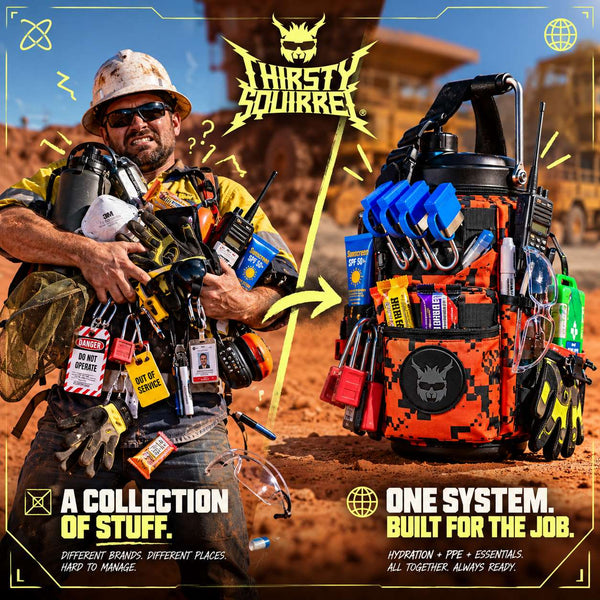
Long shifts. Remote work areas. Plenty of walking between jobs. Heat, dust, changing conditions and enough gear to fill a small hardware store.
Gloves in one place. Safety glasses somewhere else. Earplugs in the ute. Sunscreen back in the crib room.
And the water bottle? Hopefully somebody remembered to bring it.
We thought there had to be a smarter way to organise some of those everyday essentials.
That's why we developed our Thirsty Squirrel hydration system, including our OG and MOLLE storage covers.
Not because we think a water bottle is going to revolutionise workplace safety overnight.
And certainly not because carrying PPE replaces effective risk management, good supervision or properly designed workplace controls.
But because making essential equipment more convenient to carry and access can remove some of the everyday friction that gets in the way of safe behaviour.
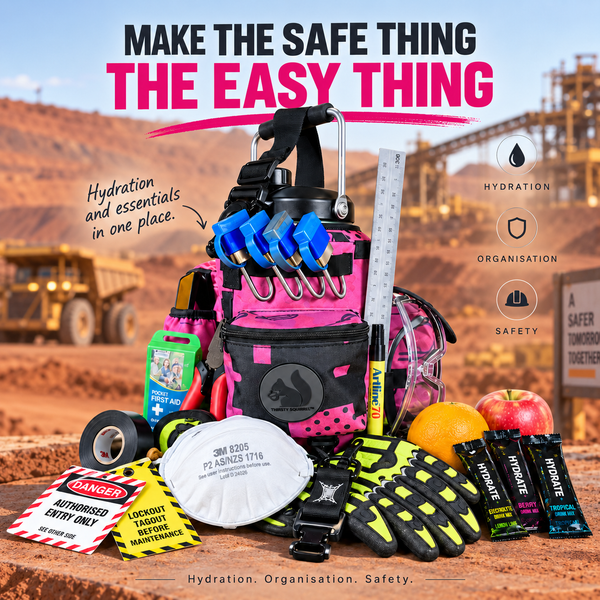
A place for your gloves. Somewhere to keep your safety glasses, earplugs, sunscreen and other essentials, as appropriate for the task.
All organised around something workers already need throughout their shift: water.
It's a small change in how equipment is carried and organised.
But sometimes meaningful improvements come from addressing the little things we have accepted as normal for far too long.
We don't need another rule reminding people that they need to wear their PPE if we've already got a system that makes accessing it unnecessarily difficult.
We need to fix the system as well.
Before the Next Incident, Ask a Different Question
Next time you observe someone without their required PPE, of course you need to address it.
But don't stop at telling them to put it on.
Ask why they weren't wearing it.
Was it unavailable? Was it uncomfortable? Was it unsuitable for the task? Was it difficult to access? Had it been damaged and not replaced? Or was it simply a decision to ignore a reasonable requirement?
The answers matter because different causes require different solutions.
Sometimes the answer will be coaching, supervision or accountability.
Other times it might be as simple as changing where equipment is stored, improving how it's issued or providing a better way for workers to carry it.
The objective shouldn't just be to catch people doing the wrong thing.
It should be to create conditions where doing the right thing is the easiest and most practical option.
Because there is one thing we know for certain.
You can't go back and put your seatbelt on after the crash.
And you can't put on the safety glasses after the particle hits your eye.
Make the safe thing the easy thing. Before it's too late.
Thirsty Squirrel — The Smart Operator.
Stay Hydrated. Stay Equipped. Stay Safe.
References — Peer-Reviewed Literature
[1] Wong, T. K. M., Man, S. S., & Chan, A. H. S. (2020). Critical factors for the use or non-use of personal protective equipment amongst construction workers. Safety Science, 126, 104663.
https://doi.org/10.1016/j.ssci.2020.104663
[2] Chellappa, V., Al-Bayati, A. J., & Luximon, Y. (2025). Determining the factors influencing noncompliance with PPE among construction workers: A multiattribute decision-making approach. Journal of Legal Affairs and Dispute Resolution in Engineering and Construction, 18(1), 04525085. Published online 2025; print issue February 2026.
https://doi.org/10.1061/JLADAH.LADR-1414
[3] Sehsah, R., El-Gilany, A.-H., & Ibrahim, A. M. (2020). Personal protective equipment (PPE) use and its relation to accidents among construction workers. La Medicina del Lavoro, 111(4), 285–295.
https://doi.org/10.23749/mdl.v111i4.9398
[4] Michie, S., van Stralen, M. M., & West, R. (2011). The behaviour change wheel: A new method for characterising and designing behaviour change interventions. Implementation Science, 6, 42.
https://doi.org/10.1186/1748-5908-6-42
[5] Dick, A., Sterr, C. M., Dapper, L., Nonnenmacher-Winter, C., & Günther, F. (2023). Tailored positioning and number of hand rub dispensers: The fundamentals for optimized hand hygiene compliance. Journal of Hospital Infection, 141, 71–79.

Shop the gear from this guide
Browse the Thirsty Squirrel products mentioned in this article.