What Does "Reasonably Practicable" Actually Mean?
04 August 2026
One of the most common phrases in workplace safety is:
"Employers must do what is reasonably practicable."
It appears throughout Australian Work Health and Safety (WHS) legislation, but many people misunderstand what it actually means.
Some think it means eliminating every risk.
Others think it simply means providing compliant PPE.
Neither is correct.
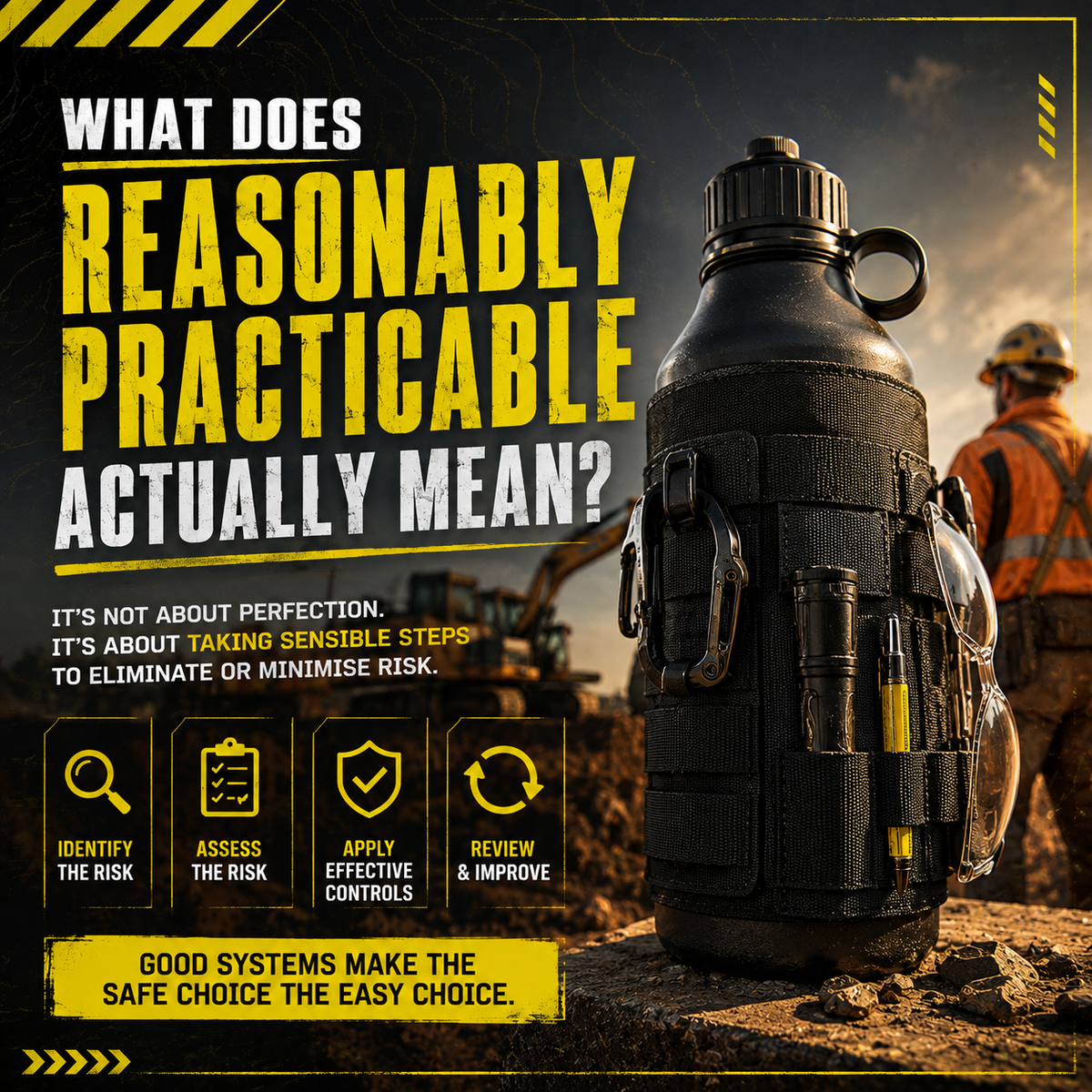
Reasonably practicable means taking sensible steps to eliminate or minimise risks by considering what could happen, how serious the consequences could be, and what effective controls are available.
It isn't about perfection.
It's about making reasonable decisions that genuinely improve safety.
Supplying PPE Isn't Enough
Imagine a company provides every worker with compliant safety glasses.
The glasses are issued.
The paperwork is signed.
The box is ticked.
Six months later, workers regularly leave them in the ute, the crib room or their locker because they're inconvenient to carry.
Someone suffers an eye injury.
The investigation won't just ask:
"Did the company provide PPE?"
It will also ask:
- Did the business know workers weren't carrying it?
- Were supervisors aware?
- Were existing controls actually working?
- Could the risk have been reduced further?
Providing PPE is essential.
Making it practical to use every day is just as important.
Good Systems Beat Good Intentions
Most people don't come to work intending to ignore safety.
They're busy, distracted and under pressure.
When safe work depends on memory or convenience, shortcuts become more likely.
That's why good safety systems remove friction.
The easier something is to do, the more likely people are to do it.
Think about a seatbelt.
It's already there when you need it.
PPE should be too.
Continuous Improvement Matters
Australian WHS legislation expects businesses to continually review whether their controls remain effective.
If a control isn't working, it should be improved where it is reasonably practicable to do so.
Sometimes that's new equipment.
Sometimes it's a better process.
Sometimes it's simply making existing PPE easier to access.
Convenience Influences Behaviour
Convenience isn't a luxury—it's part of good safety design.
When PPE is easy to carry and always within reach, workers are more likely to use it consistently.
The best safety systems don't rely on perfect workers.
They make the safest choice the easiest choice.
Final Thought
Reasonably practicable isn't about doing the bare minimum.
It's about continually asking:
"Can we make this safer?"
The safest businesses don't just buy better equipment.
They build better systems that help workers do the right thing, every shift.
Further Reading
Thirsty Squirrel
Work Health & Safety

Shop the gear from this guide
Browse the Thirsty Squirrel products mentioned in this article.