What Does a $2 Glove Clip Say About Your Safety Culture?
19 September 2026
Walk onto almost any construction, mining or industrial site and you'll probably see one.
The humble glove clip.
Usually plastic. Usually bought by the box. Usually cheap.
They get handed out at pre-starts and inductions, clipped onto someone's belt, covered in dust, thrown into utes, snapped, lost and replaced.
Nobody really thinks much about them.
And that's exactly why I started thinking about them.
Because maybe the way we treat the little things in safety tells us something about the way we approach the big things.
Safety culture isn't just what we say
Every organisation wants a strong safety culture.
We put safety values on walls. We discuss safety at pre-starts. We develop procedures, complete risk assessments, conduct inspections and remind workers that everyone has a responsibility for safety.
All of those things matter.
But workers don't form their perception of an organisation's attitude toward safety solely from policies and slogans.
They experience it.
Research into safety climate has repeatedly examined workers' perceptions of the policies, procedures and practices surrounding safety, including the priority that management actually places on it.
A review of construction-industry safety climate research found that safety policies, procedures and practices were the most commonly used indicators of safety climate, followed by management commitment to safety. The researchers also highlighted the potential gap between what an organisation says it does and what workers actually experience.
That's an important distinction.
There is the safety culture we say we have.
And then there are the hundreds of little signals workers receive every day about what actually matters.
The little things send signals
Think about what workers see.
A damaged tool that gets replaced immediately.
A supervisor stopping work when something isn't right.
A hazard report that actually results in action.
A worker raising a concern and being listened to.
Good-quality equipment being supplied instead of simply choosing the cheapest available option.
None of those things individually defines a safety culture.
But collectively, they communicate something.
Research involving construction workers has found associations between safety climate and safety behaviours, with perceptions of management and co-worker commitment to safety forming part of that relationship.
An earlier construction study similarly identified management commitment to safety and worker involvement in safety as key dimensions of safety climate.
So perhaps the question shouldn't always be:
"What does our safety policy say?"
Perhaps occasionally we should ask:
"What does the everyday experience of working here say?"
Which brings me back to the glove clip
Let's be clear.
A glove clip isn't going to transform your safety culture.
Buying a stronger glove clip won't suddenly reduce your TRIFR, fix poor supervision or compensate for inadequate risk controls.
And a glove clip itself isn't PPE.
But it sits within the ecosystem surrounding PPE.
It exists for one simple reason: to make carrying and accessing gloves easier.
And that's where the idea becomes interesting.
A lot of these products have traditionally been treated as disposable consumables.
Buy them cheaply.
Buy them in bulk.
If one breaks, grab another.
There isn't necessarily anything wrong with that approach.
But it raises a broader question:
Why do we sometimes accept poor quality simply because something is considered a "small" part of safety?
Fit for purpose should matter
Australian WHS guidance already reflects this principle when dealing with PPE itself.
Safe Work Australia says businesses should select PPE that is suitable for the worker and task, ensure workers understand its proper use and maintenance, and periodically assess whether it continues to be effective.
Here in Western Australia, WorkSafe WA similarly states that PPE should be suitable for the worker and task, reasonably comfortable, properly maintained and kept in good working order.
And importantly, PPE remains relatively low in the hierarchy of controls. It should not replace elimination, substitution, engineering or other higher-order controls where those controls are reasonably practicable.
That's an important point.
This isn't an argument for buying expensive gadgets and calling it safety.
It's an argument for something much simpler:
If we're going to provide something to workers, make sure it's fit for purpose.
Cheap and value aren't necessarily the same thing
Procurement decisions understandably involve cost.
If you have hundreds or thousands of workers, the difference between a $2 item and a more substantial alternative adds up quickly.
But purchase price isn't always the same thing as value.
If something constantly breaks, gets thrown away or needs replacing, was it actually cheap?
And there's another consideration that is harder to put into a spreadsheet.
What does the product communicate to the person receiving it?
There's a difference between:
"Here's another one. They're cheap."
and
"Here's your gear. Look after it."
One communicates disposability.
The other communicates ownership.
That distinction interests me.
Safety culture is built in the ordinary moments
We often look for the big safety initiatives.
New systems.
New technology.
New campaigns.
New procedures.
But safety culture doesn't only live in those big initiatives.
It lives in ordinary decisions.
How quickly do we repair something?
What happens when somebody reports a problem?
Do supervisors follow the same rules expected of everyone else?
Do we genuinely consult workers?
Do we buy equipment because it's suitable, or simply because it's cheap?
Do we make doing the safe thing difficult?
Or do we design work, equipment and systems so that doing the safe thing becomes the easiest option?
A meta-analysis of construction safety-climate research identified management commitment, supervisors' safety role, safety rules and procedures, individual responsibility and training among the dimensions associated with safety performance.
That reinforces something most experienced safety professionals already recognise:
People watch what organisations do, not just what they say.
That's why we made ours differently
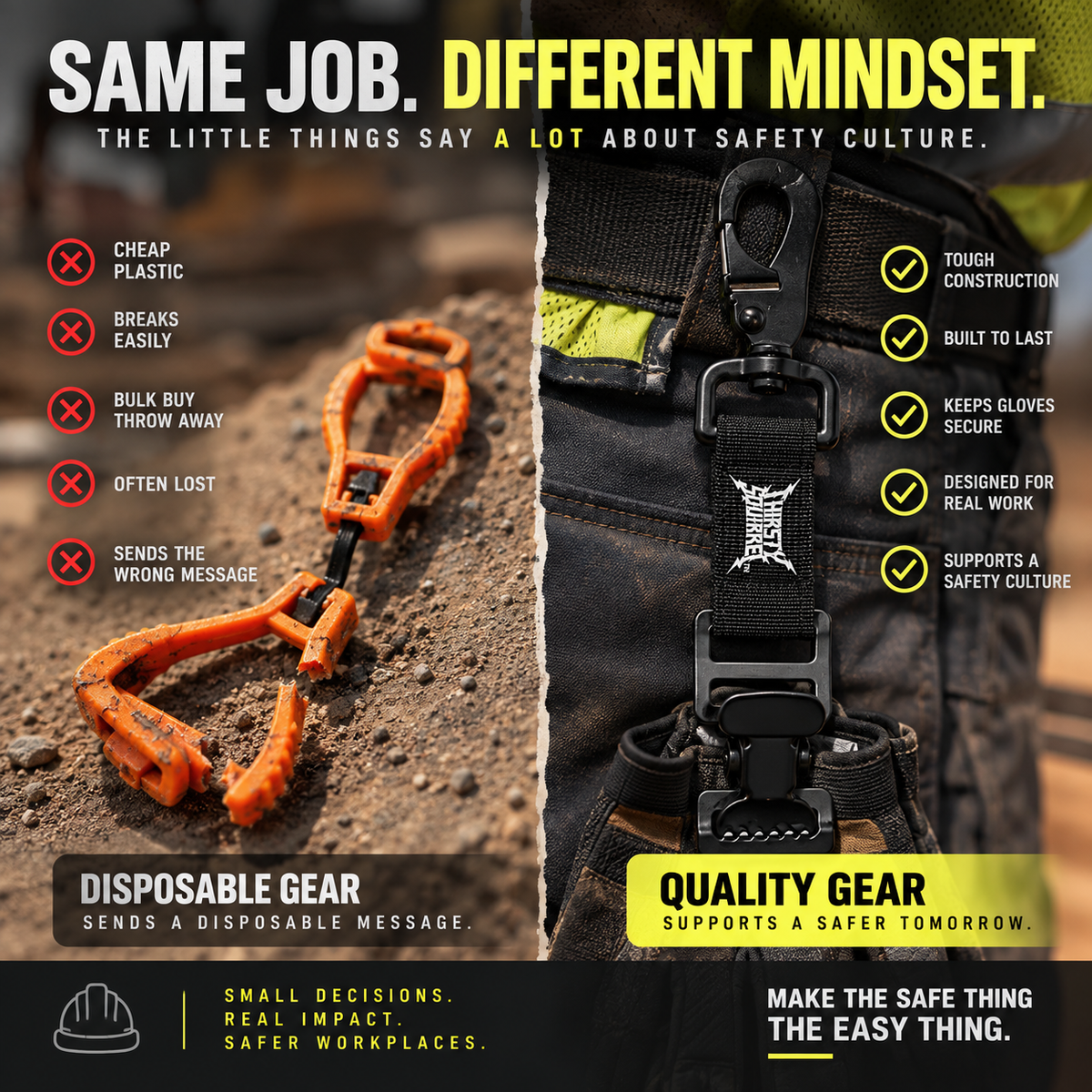
When we developed the Thirsty Squirrel glove clip, we could have made another lightweight, disposable plastic clip.
There are already plenty of those.
Instead, we wanted something that felt like a piece of kit.
Solid.
Sturdy.
Tough as nails.
Something designed to get knocked around, clipped onto workwear, thrown into a ute, covered in Pilbara dust and used again tomorrow.
Not because a glove clip is going to revolutionise workplace safety.
It won't.
But because of the principle behind it.
If something is worth making part of a worker's everyday safety kit, we reckon it's worth making properly.
And maybe that's the bigger conversation.
What are the small things saying about your safety culture?
Look around your workplace.
Not at the safety posters.
Not at the policies.
Look at the ordinary stuff.
The PPE.
The tools.
The amenities.
The condition of the equipment.
The way supervisors respond when somebody speaks up.
The little frustrations workers have learned to live with because "that's just how we've always done it."
Individually, they might seem insignificant.
Collectively, they're the everyday experience of your safety system.
And every one of them has the potential to send a message.
The little things matter.
At Thirsty Squirrel, our philosophy is simple:
Make the safe thing the easy thing.
Because good safety shouldn't just exist in a procedure.
It should be built into the way we work.
References
Safe Work Australia — Personal protective equipment (PPE): WHS duties
Guidance on selecting suitable PPE, worker consultation, use, maintenance and periodically assessing effectiveness.
WorkSafe WA — Personal protective equipment (PPE)
Western Australian guidance covering suitable PPE, consultation, maintenance and keeping PPE in good working order.
Schwatka, N.V. et al. — Defining and Measuring Safety Climate: A Review of the Construction Industry Literature
Review of construction safety-climate research examining policies, procedures, practices and management commitment.
Schwatka, N.V. & Rosecrance, J. — Safety Climate and Safety Behaviors in the Construction Industry: The Importance of Co-workers' Commitment to Safety
Research examining relationships between management, supervisors, co-workers, safety climate and safety behaviour.
Dedobbeleer, N. & Béland, F. — A Safety Climate Measure for Construction Sites
Research identifying management commitment and worker involvement as important safety-climate dimensions.
Safety Climate Dimensions and Their Relationship to Construction Safety Performance: A Meta-Analytic Review
Review and meta-analysis examining safety-climate dimensions and their relationships with construction safety performance.

Shop the gear from this guide
Browse the Thirsty Squirrel products mentioned in this article.