
Safety Is Serious. Does It Always Have to Feel So Serious?
16 September 2026
Safety is serious.
People getting hurt at work is serious. Exposure to hazards is serious. Psychological harm, fatigue, long-term illness and workplace fatalities are serious.
There’s absolutely nothing funny about any of that.
But here’s a different question:
Does the way we communicate about safety always have to be so bloody serious?
Spend enough time around WHS and you’ll see some incredibly knowledgeable people sharing important information about risk management, legislation, critical controls, psychosocial hazards, leadership, compliance and safety culture.
It matters.
But if we’re being fair dinkum, some of it can also be pretty dry.
And that raises an interesting problem.
Are we talking about safety in the places our workers are actually listening?
A significant number of the people most exposed to workplace hazards aren’t sitting at a desk scrolling through LinkedIn articles about risk matrices.
They’re operating machinery.
Driving trucks.
Pouring concrete.
Working underground.
Building things.
Maintaining equipment.
Working 12-hour shifts in 40-degree heat.
They’re dealing with production requirements, fatigue, changing conditions, paperwork, procedures, permits, pre-starts, Take 5s, toolbox meetings and the hundred other things competing for their attention.
That doesn’t mean frontline workers don’t care about safety.
Far from it.
But it does mean we should think seriously about how we engage them.
Safe Work Australia says effective WHS consultation should suit the workplace and the workers involved, and can happen through toolbox talks, pre-start meetings and ordinary interactions at work — not simply through formal communication channels.
That matters.
Because communication isn’t successful because we delivered the message.
It’s successful when somebody actually hears it, understands it and does something with it.
Safety culture is about people
We talk constantly about building a positive safety culture.
And rightly so.
Safe Work Australia identifies worker involvement and consultation as important parts of developing healthy, safe and productive workplaces. Workers are also more likely to engage when they believe their ideas and concerns are genuinely taken seriously.
But culture isn’t created by a procedure sitting in SharePoint.
It’s created between people.
During conversations.
During pre-start.
While doing the job.
When someone notices something doesn’t look right.
When an apprentice feels comfortable questioning a supervisor.
When somebody admits they made a mistake.
When a worker says, “Mate, I reckon there’s a better way to do this.”
That last part is particularly important.
If we want people speaking up, participating and thinking about risk, we need environments where people actually feel comfortable doing it.
And maybe there’s room for a little more personality in how we get there.
What if we had a bit more fun with safety?
This isn't an argument for turning serious hazards into jokes.
It’s an argument for recognising that having fun while talking about safety is very different from making fun of safety.
Humour is already part of most workplaces.
Walk around a construction site, workshop, mine site or maintenance crew and you’ll hear it.
People take the piss.
They laugh.
They develop nicknames.
They tell stories.
They give each other grief.
It’s part of how crews connect.
So rather than pretending that part of workplace culture doesn’t exist, maybe we should understand how it can be used positively.
A 2025 review published in the Annual Review of Organizational Psychology and Organizational Behavior found that workplace humour can play a role in communication, trust and cooperation. Importantly, the researchers also emphasised that humour is complex and can produce positive or negative outcomes depending on how it is used.
More recent research has made the distinction even clearer.
A 2025 study examining leader humour found that affiliative humour — humour that helps people connect — was associated with greater psychological safety, while aggressive humour had the opposite relationship.
Another study published in 2026 found an association between leader self-deprecating humour, relationship quality, employee wellbeing and psychological safety.
That doesn't mean cracking jokes is suddenly a risk control.
It isn't.
And humour isn't going to replace engineering controls, competent supervision, training, consultation or good work design.
But it does suggest something worth thinking about:
How people feel around each other influences how they communicate with each other.
And communication matters enormously in safety.
Psychological safety and psychosocial safety aren't exactly the same thing
There is an important distinction here.
When researchers talk about psychological safety, they are generally talking about whether people feel comfortable speaking up, asking questions, admitting mistakes or raising concerns without fearing humiliation or punishment.
Psychosocial safety in WHS is broader.
WorkSafe WA describes psychosocial hazards as factors arising from the design or management of work, the work environment and workplace interactions that can cause psychological or physical harm. These can include excessive demands, fatigue, poor support, low role clarity, harmful behaviours, remote work and poor organisational culture.
So having a laugh doesn't remove psychosocial hazards.
You can't pizza-party your way out of excessive workloads, bullying, poor leadership or chronic fatigue.
Those risks need to be identified and properly managed.
But creating a workplace where people connect, communicate, participate and feel comfortable speaking up can still form part of the wider culture we are trying to build.
Engagement matters
One of the risks with safety communication is that we become so accustomed to our own systems that we stop considering how workers experience them.
Another procedure.
Another PowerPoint.
Another poster.
Another mandatory training module.
Another toolbox topic read word-for-word from a page.
Technically, we've communicated.
But did anyone actually engage?
Interestingly, feedback published by Safe Work Australia in March 2026 as part of its Best Practice Review of the model WHS laws included businesses calling for WHS requirements that are simple to understand and industry based, while worker organisations highlighted stronger consultation and participation.
Different perspectives, but there is a common thread:
WHS needs to work for the humans doing the work.
That's something we believe strongly at Thirsty Squirrel.
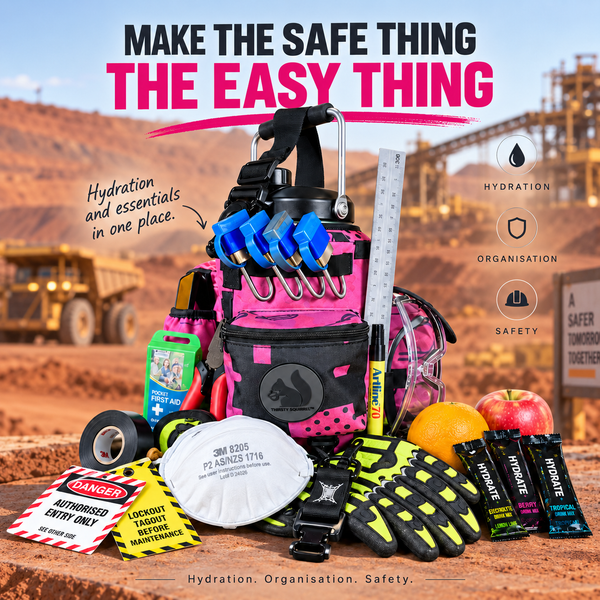
Make the right thing the easy thing.
Make PPE easy to access.
Make hydration easy.
Make communication relatable.
Make participation normal.
And, where appropriate, make it enjoyable.
The bloke dancing in his Steezies still has to follow the procedure
This is where some people might get nervous.
“If we make safety funny, won't people stop taking it seriously?”
Not necessarily.
You can laugh at work and still isolate equipment correctly.
You can have personality and still wear respiratory protection.
You can dance around in your Steezies and still follow the SWMS.
You can have a laugh at a toolbox meeting and still understand the critical controls.
The two things aren't mutually exclusive.
In fact, the bigger question might be whether constantly communicating safety through fear, compliance and seriousness is always the most effective way to connect with every worker.
Sometimes we may need the serious conversation.
Sometimes we need technical training.
Sometimes we need clear direction with absolutely no ambiguity.
And sometimes a laugh gets someone's attention long enough for a message to stick.
Knowing the difference is part of good leadership.
Humour needs boundaries
There is another side to this conversation.
Not all humour builds culture.
Humour directed at somebody can quickly become humiliation.
Repeated “banter” can become bullying.
Jokes based on someone's gender, culture, sexuality, age, ability or personal circumstances can make people feel less safe, not more.
Research into workplace humour consistently points toward this distinction: positive, inclusive humour can strengthen relationships, while aggressive or negative humour can undermine psychological safety.
So the rule is pretty straightforward.
Laugh with people, not at them.
Good workplace humour should bring the crew together.
Not decide who gets pushed outside it.
Maybe good safety culture can look different
Perhaps we've accidentally created an image of what “good safety” is supposed to look like.
Serious face.
Clipboard.
Hi-vis.
Procedure in hand.
Nothing wrong with any of that.
But maybe good safety culture can also look like a supervisor having a laugh with the crew before asking a genuine question about a hazard.
Maybe it looks like workers comfortable enough to admit they don't understand something.
Maybe it looks like an apprentice calling something out without being made to feel stupid.
Maybe it looks like people actually enjoying the gear they're wearing.
Maybe it looks like safety communications people actually want to watch.
Maybe occasionally...
it looks like someone dancing around in a pair of Steezies.
We're not suggesting safety become a comedy show.
We're suggesting that safety communication should understand its audience.
Because procedures matter.
Controls matter.
Compliance matters.
But ultimately, safety happens through people.
And if attitude, participation, communication and culture are genuinely important to WHS, then perhaps creating workplaces with a little more connection, humour and personality deserves a place in the conversation too.
Safety is serious.
That doesn't mean we have to be miserable while doing it.
Further reading
Safe Work Australia — How to consult with workers: practical guidance on consultation methods and adapting communication to workers and workplaces. How to consult with workers – Safe Work Australia
WorkSafe WA — Psychosocial hazards overview: current WA guidance on psychosocial hazards, their impacts and WHS responsibilities. Psychosocial hazards overview – WorkSafe WA
WorkSafe WA — Common work-related psychosocial hazards and risk factors: useful guidance covering work demands, support, culture, fatigue, burnout and harmful workplace behaviours. Common psychosocial hazards – WorkSafe WA
Safe Work Australia — Best Practice Review of the model WHS laws: consultation summary, published 17 March 2026. Read the 2026 WHS consultation summary
Cooper & Schweitzer — Organizational Humor: A Foundation for Future Scholarship, a Review, and a Call to Action, Annual Review of Organizational Psychology and Organizational Behavior, 2025. Read the organisational humour review
Sohr, Knaut & Kowalski — Effects of leader self-deprecating humor on employee well-being and psychological safety, published January 2026. Read the 2026 study
Thirsty Squirrel — Make the safe thing the easy thing.

Shop the gear from this guide
Browse the Thirsty Squirrel products mentioned in this article.