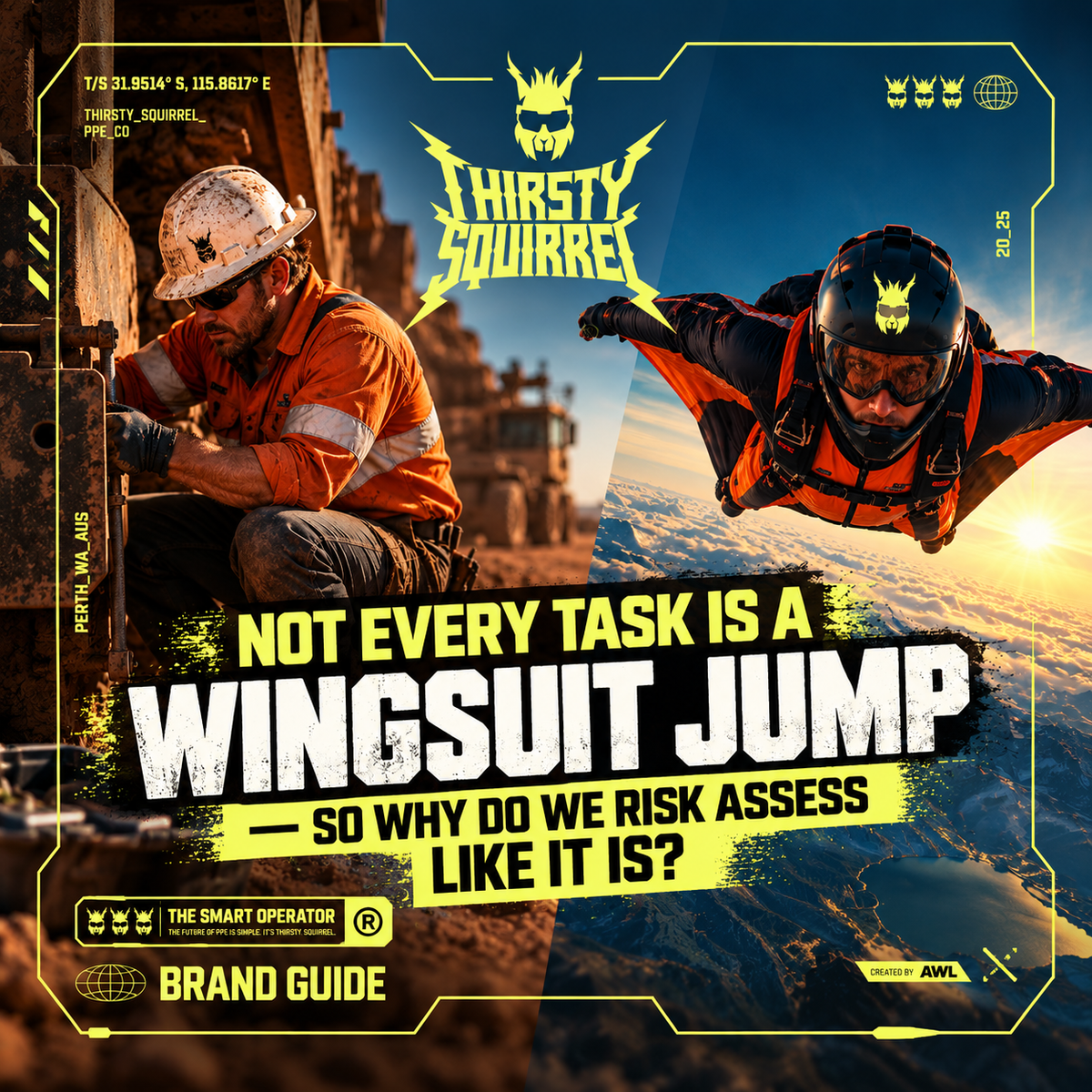
Not Every Task Is a Wingsuit Jump — So Why Do We Risk Assess Like It Is?
28 September 2026
Thirsty Squirrel is proud to be sponsoring members of the Australian Wingsuit Team as they head to California to compete at the World Championships.
That got me thinking about risk.
Wingsuit flying is objectively an activity where getting something badly wrong can have catastrophic consequences. You are exiting an aircraft at altitude, flying at significant speed with restricted movement, operating in proximity to other people and an aircraft, and ultimately relying on a parachute system to return safely to the ground.
You would expect the risk management around that to be serious.
And it is.
But looking at how wingsuit flying manages risk raises an interesting question for those of us working in industries like mining and construction:
Why do we sometimes expect someone completing a relatively simple, low-risk task to approach risk assessment with almost the same administrative intensity as someone preparing to jump out of an aeroplane?
When the consequence is obvious
In the United States, where the championships are being held, the United States Parachute Association requires someone performing a wingsuit jump to have at least 200 skydives and hold a current skydiving licence. Wingsuit pilots are expected to understand aircraft movements, exit order, separation, flight paths, parachute deployment, canopy flight and landing patterns.
Training places considerable emphasis on competence and rehearsed behaviour. USPA material describes first-flight training covering exits, stable flight, practice pulls and stable deployment.
There is plenty of governance behind the activity, so this isn't an argument that wingsuit pilots simply turn up, have a quick chat and jump out of an aircraft.
But there is something interesting happening at the individual level.
The wingsuit pilot understands the potential consequence.
They don't need a risk matrix to convince them that striking the aircraft, colliding with another flyer, losing situational awareness or failing to deploy their parachute correctly could have devastating consequences.
The risk is real to them.
And because the consequence is real, the controls are real too.
Competence matters. Equipment matters. Separation matters. Altitude matters. Exit technique matters. Deployment matters. Conditions matter.
The person performing the activity has a very strong personal reason to pay attention.
Now come back to a mine site
Imagine a worker has been asked to perform a simple maintenance task.
Perhaps they need to replace a mudflap, install a small bracket, tighten a fitting, move some materials or complete another familiar low-risk job.
There are hazards. There are always hazards.
Maybe they could pinch a finger. Maybe they could scrape a knuckle. Perhaps there's some manual-handling exposure. Perhaps a tool could slip.
Those risks shouldn't simply be ignored.
But the credible consequence for many of these hazards might genuinely be relatively minor.
Yet depending on the organisation and site, the worker may still be expected to complete a Take 5, review a JHA or JSA, identify numerous hazards, assign risk ratings, identify controls, confirm PPE, acknowledge procedures and potentially obtain additional authorisations before beginning.
Then tomorrow they perform another task where uncontrolled energy, mobile plant, working at height or another potentially fatal hazard is present.
And we ask them to go through a remarkably similar process.
That's where I think we need to ask ourselves an uncomfortable question.
Are we teaching people to take risk seriously, or are we teaching them to complete risk assessments?
Human attention isn't unlimited
Imagine giving someone a pre-task assessment containing 25 hazards.
Twenty-three could realistically cause relatively minor injuries.
Two could kill them.
From a documentation perspective, identifying all 25 might look comprehensive.
From a human perspective, however, we may have just placed the two things we desperately need that worker to understand amongst another 23 things competing for their attention.
That's not necessarily better risk management.
It's potentially just more risk information.
There is an important distinction between saying every hazard should be considered and saying every hazard deserves the same amount of attention.
They don't.
A cut finger and an uncontrolled interaction with heavy mobile equipment are both workplace risks. Both should be appropriately managed. But they shouldn't necessarily compete equally for a worker's attention.
In fact, Australian WHS guidance already recognises this concept.
Safe Work Australia describes risk assessment as considering what could happen and the likelihood of it happening, and says this helps determine how severe the risk is and how urgently action is required. It also specifically notes that a risk assessment step may not be necessary where the hazards, risks and controls are already well known.
WA guidance on what is "reasonably practicable" makes the proportionality even clearer: the greater the potential degree of harm, the greater its significance when determining what should reasonably be done. The guidance specifically states that more would be expected to eliminate or minimise a risk of death or serious injury than a risk involving lesser harm.
So perhaps proportionality isn't contrary to good safety management at all.
Perhaps it is fundamental to it.
Treat every risk seriously. Don't treat every risk equally.
This is where mining's increasing focus on critical controls becomes particularly relevant.
The International Council on Mining and Metals' Critical Control Management approach deliberately focuses attention on the controls that prevent or mitigate serious unwanted events. Its guidance identifies fatal hazards and unwanted events, selects the controls that are genuinely critical, defines how those controls should perform and then verifies that they are actually working.
That philosophy makes sense.
Because workers only have so much attention.
Every procedure, checklist, warning, form, signature, hazard, control and instruction consumes a little of it.
If we tell workers that everything is critical, eventually the word critical doesn't mean very much.
If every task requires the same ritual, regardless of consequence, eventually workers can become very good at performing the ritual.
Tick. Tick. Tick. Sign. Start.
The danger is that completing the process becomes the objective rather than understanding the risk.
The wingsuit pilot has something we should want
A wingsuit pilot doesn't check critical equipment because an auditor might ask whether they did.
They aren't thinking about separation because there is a KPI requiring 95% compliance with pre-jump assessments.
They aren't monitoring altitude because somebody might check the paperwork next week.
They understand what can kill them.
More importantly, they understand the controls that help stop that from happening.
That doesn't mean workplaces should rely on fear, personal judgement or experience alone. Workplace safety obligations exist for very good reasons, and workers shouldn't have to learn critical lessons through experience or injury.
But perhaps there is something worth learning from the clarity involved.
For genuinely high-consequence risks, our attention should increase dramatically.
If there is potential for a fatality or serious injury, slow down. Understand the exposure. Confirm competency. Identify the critical controls. Verify they are actually in place and effective. Make sure the people exposed understand exactly what can go wrong and what prevents it.
Give those risks the attention they deserve.
For a simple, familiar task with well-understood hazards and genuinely low potential consequences, perhaps the objective should be equally clear: identify what matters, apply the established controls and get on with the work safely.
Not irresponsibly.
Proportionately.
Are we managing risk, or distributing attention evenly?
Maybe that's the question we should be asking.
Because the purpose of risk assessment was never to demonstrate that every conceivable hazard received exactly the same administrative treatment.
The purpose is to prevent people from being harmed.
And if we consume a worker's attention asking them to repeatedly document low-consequence, well-understood risks, we should at least consider whether we're leaving them with less attention for the moments when we desperately need it.
When someone is about to perform work where a control failure could kill them, I want their attention completely focused on that risk.
What's the energy source? Where is the mobile equipment? What stops the load falling? What prevents the person entering the line of fire? What happens if this control fails? How do I know the isolation is effective?
Those questions matter.
The paperwork only matters if it helps answer them.
Perhaps the goal shouldn't be to make every worker risk assess every task as though they're about to jump out of an aeroplane.
Perhaps the goal should be to build a workforce capable of recognising when they actually are standing at the metaphorical aircraft door.
Then make damn sure they know exactly what needs to work before they jump.
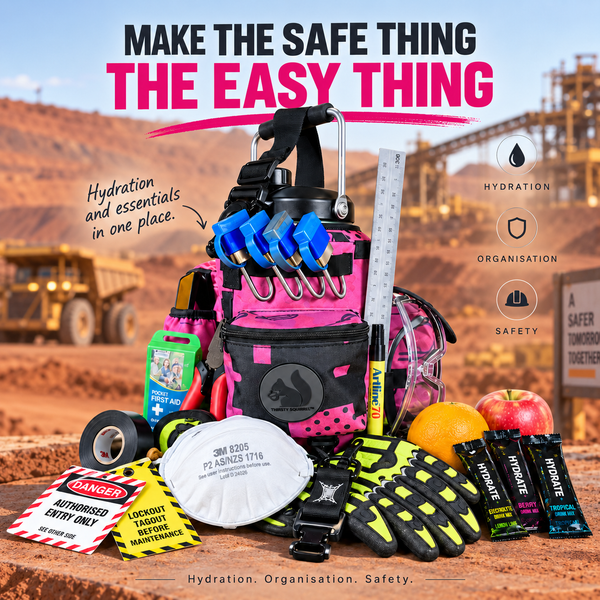
At Thirsty Squirrel, we talk a lot about making the safe thing the easy thing. That doesn't mean removing risk management. It means making safety systems clearer, more practical and more focused on the things that actually prevent people getting hurt.
Because good safety isn't measured by how much attention we demand.
It's measured by whether we've focused that attention on the things that matter most.

Shop the gear from this guide
Browse the Thirsty Squirrel products mentioned in this article.