Has Safety Become Too Academic for the People It Is Supposed to Protect?
23 September 2026
Safety has become incredibly sophisticated.
We have better research.
Better technology.
Better data.
More qualified professionals.
More detailed risk assessments.
More procedures, systems, dashboards, matrices, classifications and methodologies than we've probably ever had before.
And much of that progress is genuinely valuable.
But I think there is a question worth asking:
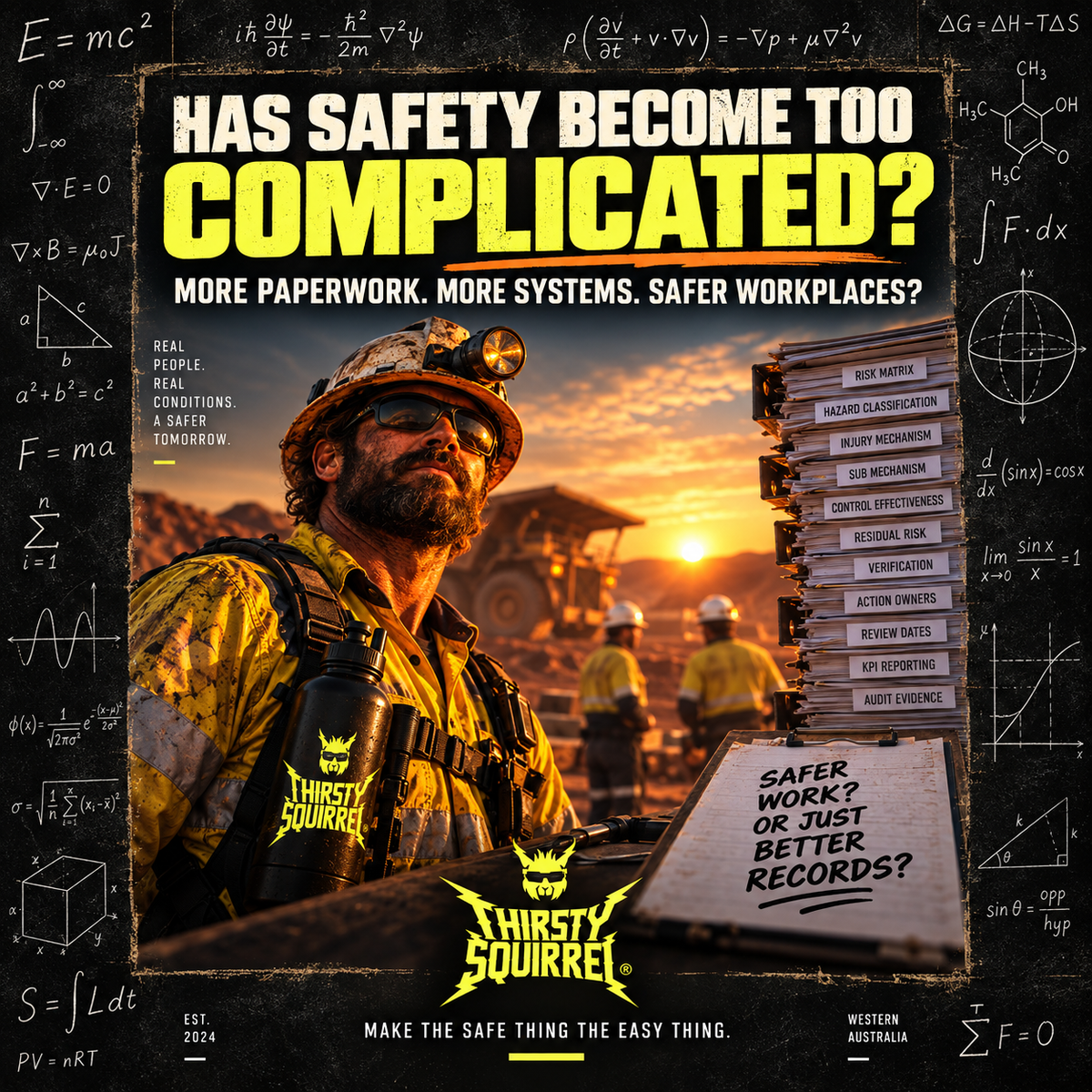
Has safety become so sophisticated that we're sometimes making it harder for the people actually doing the work to engage with it?
Because ultimately, safety doesn't happen in a spreadsheet.
It happens where the risk exists.
On the workshop floor.
Inside the processing plant.
Beside the excavator.
On the construction site.
Behind the wheel of a truck.
In 45-degree heat in the Pilbara.
And if the people standing in those places don't understand, use or believe in the safety systems we've created, we need to question how effective those systems really are.
Intelligence and academia are not the same thing
This distinction is important.
Saying that many frontline workers aren't academic is absolutely not the same thing as saying they aren't intelligent.
Some of the smartest people I've worked with would probably have very little interest in writing an academic paper.
Give them a mechanical problem, a piece of equipment that isn't behaving properly, an operational challenge or an unexpected change in conditions and they'll solve it before most of us have finished organising the meeting.
That's intelligence.
It's experience.
Pattern recognition.
Practical knowledge.
Problem solving.
And in safety, we should be tapping into that knowledge rather than designing systems that inadvertently exclude it.
Research into worker participation in Australian mining has previously found that meaningful worker involvement in occupational health and safety generally produces better outcomes than unilateral management approaches.
Yet sometimes our safety systems seem to be heading in the opposite direction.
They are becoming increasingly technical, increasingly specialised and increasingly difficult for the average person doing the job to navigate.
The 300-row risk assessment
I've sat in risk assessments that have become enormous.
Forty-plus columns.
Hundreds of rows.
Hazards.
Risks.
Mechanisms.
Sub-mechanisms.
Causes.
Consequences.
Initial risk.
Controls.
Control effectiveness.
Residual risk.
Control owners.
Verification methods.
Critical controls.
Performance standards.
Supporting documentation.
Eventually you end up with a technically impressive document.
It can withstand an audit.
It can produce data.
It can populate dashboards.
It can generate statistics.
But there is one question I think we need to ask far more often:
Did it actually make the job safer?
More importantly:
Does the person doing the job even know it exists?
Because if we spend hundreds of hours developing a technically brilliant risk assessment that sits inside a document management system while the person exposed to the risk has never seen it, we may have confused the administration of safety with the outcome of safety.
And there is research describing exactly this problem.
Safety work isn't necessarily the safety of work
Researchers Andrew Rae and David Provan and their colleagues have made an important distinction between “safety work” and the “safety of work.”
Safety work includes the activities organisations perform in the name of managing safety.
Audits.
Reports.
Meetings.
Forms.
Procedures.
Risk assessments.
Inspections.
Statistics.
Dashboards.
Investigations.
All of these things can be valuable.
But doing more safety work doesn't automatically mean the work itself becomes safer.
Their research argues that safety activities can sometimes serve organisational purposes other than improving operational safety.
That doesn't mean we throw away safety management systems.
Far from it.
It means we should continually test whether the things we're asking people to do actually contribute to controlling risk.
There's even a name for it: Safety Clutter
Rae, Provan, Weber and Dekker described “safety clutter” as the accumulation of safety procedures, documents, roles and activities performed in the name of safety that don't actually contribute to operational safety.
Their research identified duplication, generalisation and over-specification as important ways this clutter develops.
Perhaps even more importantly, they warned that excessive safety clutter can contribute to cynicism and “surface compliance.”
That's worth thinking about.
Because we've all seen surface compliance.
The form gets signed.
The boxes get ticked.
The meeting attendance sheet gets completed.
The inspection gets entered.
The KPI turns green.
Everyone moves on.
Administratively, everything looks fantastic.
Operationally?
Maybe nothing changed.
And this isn't just an older academic argument.
A peer-reviewed 2026 study published in the Journal of Safety Research examined safety clutter specifically within construction.
Researchers used expert focus groups and observations across 11 active jobsites and described safety clutter as safety effort that consumes attention, effort and resources without improving the safety of work.
They identified excessive, irrelevant, inaccessible and invalid forms of safety clutter.
That's an incredibly important distinction.
The argument isn't that safety is unnecessary.
It's that ineffective safety activity competes for the same limited attention as effective safety activity.
Complexity has a cost
Every additional form.
Every additional field.
Every additional classification.
Every additional approval.
Every additional procedure.
Individually, they might seem reasonable.
Collectively, they can create enormous complexity.
Research into the bureaucratisation of safety has recognised that formalisation has delivered real benefits including standardisation, transparency and control.
But it has also identified unintended consequences including diminishing returns, “numbers games,” additional administrative burdens and constraints on innovation.
That should make us uncomfortable enough to keep asking questions.
Because human attention isn't unlimited.
If we bury the controls that actually matter underneath hundreds of pieces of information that don't, we haven't necessarily strengthened the system.
We may have diluted it.
Work as imagined versus work as done
There is another concept in safety research that I think every safety professional should spend some time thinking about:
Work as Imagined versus Work as Done.
Work as Imagined is essentially how we believe the job happens when we design the system, procedure or risk assessment.
Work as Done is what actually happens when someone performs that task in the real world.
With real equipment.
Real weather.
Real production pressures.
Real interruptions.
Real experience.
And real variability.
Research into safety systems increasingly recognises that there can be significant differences between the two.
A 2026 study of procedural work in a petrochemical facility found that successful operations frequently involved variation from the written procedure, with context accounting for most of that variation. The researchers argued that procedural variation can represent functional adaptation rather than simply worker non-compliance.
That doesn't mean procedures don't matter.
It means the people writing them need to understand the environment in which they're actually being used.
Bring the person doing the job back into the conversation
One of the easiest questions we can ask when designing a safety process is:
“Would the person doing this job actually use this?”
Not:
Will it pass an audit?
Can we measure it?
Can we report against it?
Can we add it to the dashboard?
Those questions have their place.
But first:
Does it help someone manage the risk?
Research into procedure compliance supports this idea. One study found that workers were more likely to comply with procedures when the people using those procedures were involved in their development.
Other research has found that workers' perception of whether a procedure is actually useful influences the effort they put into following it.
That's hardly surprising.
People engage with things that make sense.
Translate the research
None of this is an argument against academia.
Quite the opposite.
We need researchers.
We need evidence.
We need universities challenging existing thinking.
We need better understanding of human factors, organisational psychology, engineering, occupational hygiene, psychosocial risk, critical controls and the hundreds of other disciplines that contribute to modern safety.
But the job isn't finished when the research paper gets published.
Someone has to translate it.
From research into systems.
From systems into tools.
From tools into behaviours.
And from behaviours into something a worker can actually use at 2:30pm on a hot Tuesday afternoon when something about the job has changed.
That's where safety becomes real.
Maybe good safety should feel simpler
The sophistication can exist behind the scenes.
The engineering can be complex.
The research can be complex.
The analysis can be complex.
But perhaps what reaches the worker should often be incredibly simple.
What's going to hurt me?
What are the controls that really matter?
Are those controls actually working?
What has changed?
What do I do if something doesn't look right?
If somebody can confidently answer those questions, we've probably achieved more than handing them another 40-page procedure.
That's part of what we're trying to do at Thirsty Squirrel
Thirsty Squirrel isn't trying to reinvent safety science.
We're trying to apply a very simple principle:
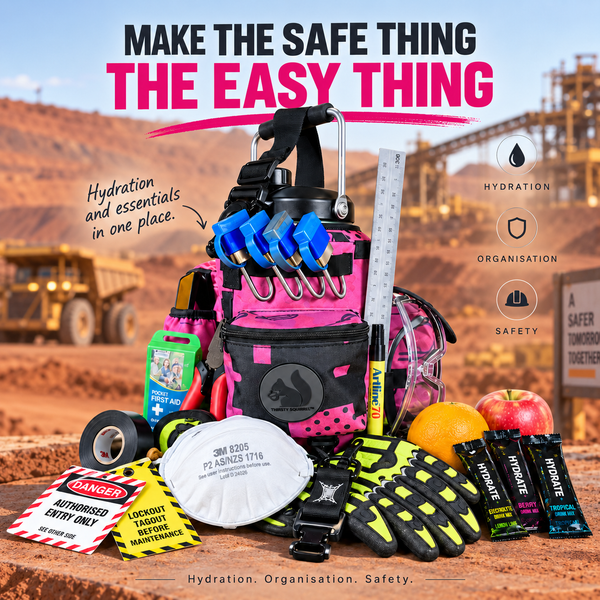
Make the safe thing the easy thing.
Hydration is a good example.
We can write hydration management plans.
Develop heat-stress procedures.
Conduct risk assessments.
Run toolbox talks.
Record temperatures.
Develop hydration guidance.
And there can be good reasons for doing all of those things.
But eventually a worker standing in the heat still needs to drink water.
So how do we make that easier?
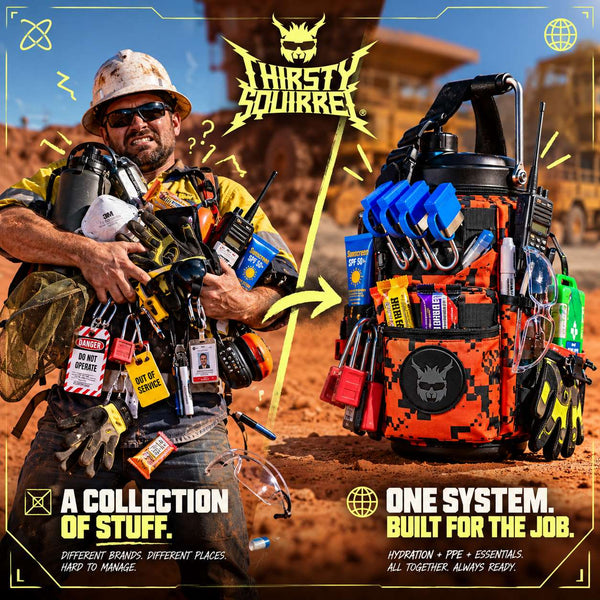
Give them a bottle capable of carrying enough water.
Keep that water cooler for longer.
Make the bottle practical enough that they'll actually take it with them.
Give them somewhere to keep the small pieces of PPE and equipment they need throughout the day.
Reduce friction between knowing the safe thing to do and actually doing it.
That's the philosophy behind what we're building.
Not more safety.
More usable safety.
Because perhaps the next major improvement in workplace safety isn't another layer of complexity.
Perhaps it's taking decades of research, knowledge and experience and getting much better at translating it into something meaningful for the person standing closest to the risk.
Safety can be sophisticated without being complicated.
And if the person doing the job can't understand, access or use the system we've created for them, maybe the question shouldn't always be:
“Why aren't they following the system?”
Maybe sometimes we should ask:
“Who exactly did we design the system for?”
Research referenced
Rae, Provan, Weber & Dekker (2018) — Safety clutter: the accumulation and persistence of ‘safety’ work that does not contribute to operational safety
Read the peer-reviewed article
Raheemy, Hallowell, Lingard & Sherratt (2026) — Safety clutter: An attribute-based conceptualization and taxonomy for diagnosis
Journal of Safety Research article
Rae & Provan — Safety work versus the safety of work
Read the Safety Science research
Dekker (2014) — The bureaucratization of safety
Read the Safety Science article
Procedural compliance and worker involvement — Are you sure you want me to follow this?
Read the research
Procedure engagement and perceived usefulness — A new look at compliance with work procedures
Read the research
Beyond compliance: investigating Work-as-Done in procedural work (2026)
Read the 2026 Safety Science research
Gunningham — Worker participation in OHS and the mining industry
Read the Australian mining research

Shop the gear from this guide
Browse the Thirsty Squirrel products mentioned in this article.