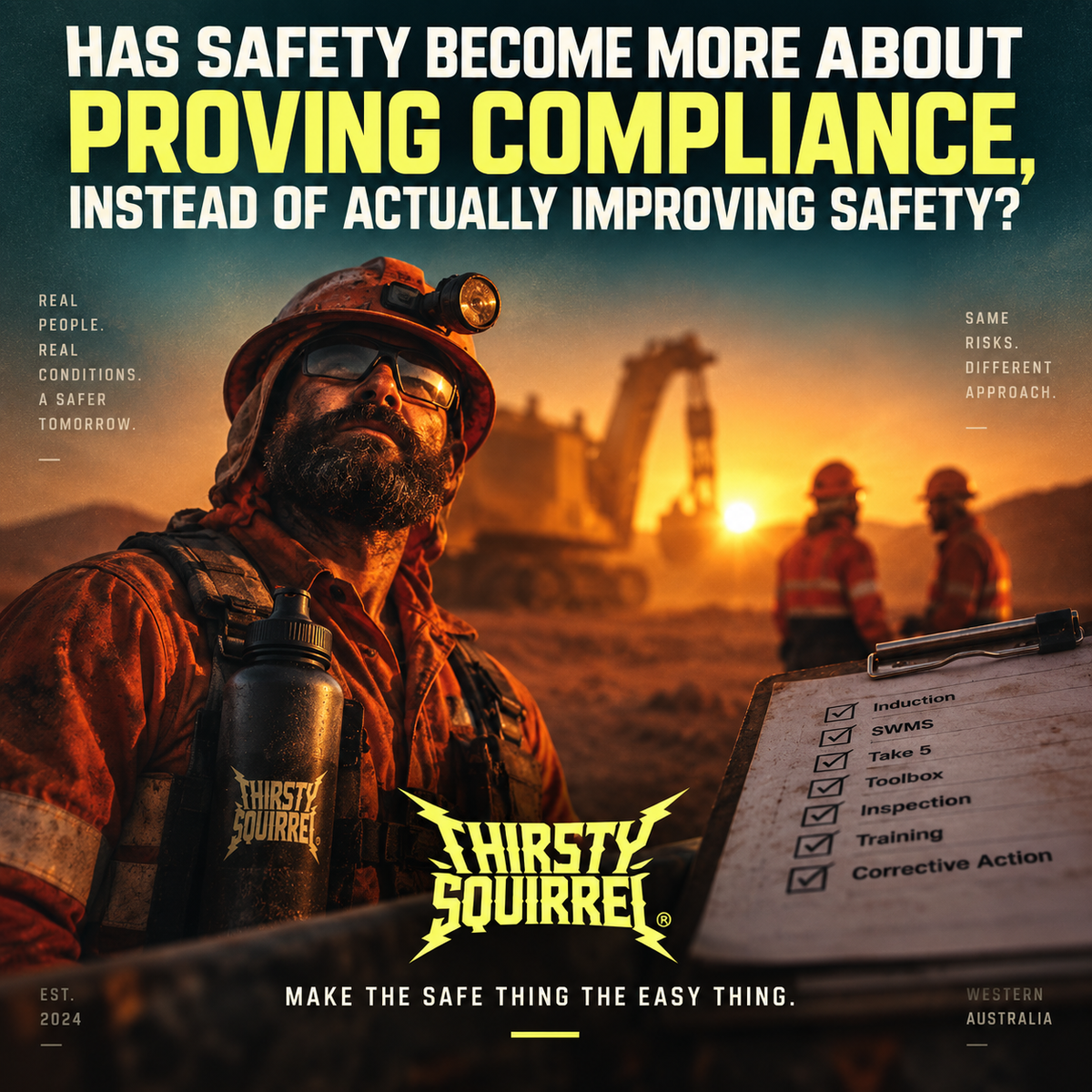
Has Safety Become More About Proving Compliance Instead of Actually Improving Safety?
21 September 2026
Somewhere along the way, we became incredibly good at proving that safety happened.
Signed forms.
Completed inductions.
SWMS acknowledgements.
Take 5s.
Pre-starts.
Toolbox attendance sheets.
Training records.
Inspections.
Corrective actions.
We can measure it. Audit it. File it. Retrieve it.
And if something goes wrong, we can produce it.
But there’s a question we probably don’t ask often enough:
Did it actually make the job safer?
Because completing a safety activity and improving safety aren't necessarily the same thing.
And perhaps that's a conversation worth having.
First, this isn't an argument against compliance
Let's get that out of the way.
Work health and safety legislation exists for good reason.
Businesses need systems. Workers need training. Risks need to be identified and controlled. Records sometimes need to be kept. People need accountability.
And when something goes wrong, organisations should be able to demonstrate what they did to manage the risk.
The problem isn't compliance.
The problem starts when proving compliance becomes the objective rather than improving safety.
Interestingly, even Australia's national WHS strategy points towards this distinction.
Safe Work Australia's current Australian Work Health and Safety Strategy 2023–2033 calls for a shift from simply understanding "how to do WHS" towards understanding "why we do WHS." Its national vision remains "Safe and healthy work for all."
That's a subtle but important difference.
Because the purpose of safety isn't a completed form.
It's someone going home safely.
The paperwork can say one thing. The workplace can say another.
Imagine two workplaces.
In the first, every document is perfect.
The SWMS is signed.
The Take 5 is completed.
The worker attended the induction.
The toolbox was recorded.
The inspection was closed out.
Everything has a green tick beside it.
But the worker is still struggling with poorly designed equipment, an impractical procedure, production pressure or a control that doesn't really work in the field.
Now imagine another workplace.
The supervisor notices the job isn't working as planned.
They stop.
Talk to the people actually doing it.
Change the setup.
Move equipment.
Introduce a better physical control.
Then update the paperwork to reflect how the work can actually be performed safely.
Which workplace has the better safety system?
The one with the best evidence?
Or the one that changed the conditions of work?
Ideally, of course, you want both.
But when forced to choose where our attention goes, the actual control of risk has to matter more than the appearance of control.
Safety researchers actually have a name for part of this problem
It's called "safety clutter."
Researchers Andrew Rae, David Provan, Drew Weber and Sidney Dekker described safety clutter as the accumulation and persistence of safety work that doesn't contribute to operational safety. The concept isn't an argument for abandoning systems or documentation; it's a challenge to examine whether every safety activity we accumulate genuinely contributes to safer work.
That's a bloody interesting concept.
Because safety systems rarely seem to get smaller.
Something happens.
We add a form.
Something nearly happens.
We add a checklist.
An audit finds a gap.
We add a procedure.
A client requests something.
We add another verification.
Five years later, nobody quite remembers why half of it exists.
But nobody wants to be the person who removes it either.
Because what if something happens?
And so safety systems can grow.
Not necessarily because every additional requirement makes people safer, but because each requirement makes the organisation feel a little more protected.
Are we managing risk — or evidence of risk management?
That's where this becomes uncomfortable.
Because after an incident, documentation matters.
What training did the worker receive?
What procedure applied?
Was the hazard identified?
Was the worker competent?
Was the equipment maintained?
Were workers consulted?
What controls were implemented?
Those are legitimate questions.
But if we aren't careful, knowing those questions may eventually be asked can influence how safety systems are designed.
We can start building systems that are extremely good at answering:
"Can we prove we told them?"
instead of:
"Did we make it easier for them to work safely?"
They're not the same question.
Research into safety practice has explored this distinction between "safety work"—the activities organisations undertake to manage and demonstrate safety—and the actual "safety of work."
That doesn't mean documentation is pointless.
It means documentation should support the control of risk rather than become a substitute for it.
The hierarchy of controls should tell us something
This is where traditional risk management gives us a useful reality check.
Safe Work Australia says risks should first be eliminated where possible and otherwise minimised so far as reasonably practicable. It also explicitly notes that administrative controls and PPE are the least effective controls because they don't control the hazard at its source and rely on human behaviour and supervision.
Think about that for a moment.
A procedure is an administrative control.
A sign is an administrative control.
Training can support risk management, but telling someone how to behave doesn't physically remove a hazard.
Yet administrative activities are often incredibly easy to measure.
Training completed: 98%.
Take 5 compliance: 96%.
Toolbox completion: 100%.
Fantastic.
But what percentage of hazards were eliminated?
How many frustrating tasks were redesigned?
How many times did someone on the tools suggest a better way of doing something and actually see it implemented?
How many controls became easier to use?
Those numbers are much harder to put on a dashboard.
But perhaps they're closer to the questions that matter.
And workers probably know more than our forms do
One of the simplest ideas in WHS is also one of the most powerful:
Talk to the people doing the job.
Safe Work Australia's current risk-management guidance says workers must be consulted throughout the risk-management process and specifically recognises that workers bring knowledge, experience and ideas that can help manage WHS risks.
WorkSafe WA makes the same point in its guidance on managing WHS risks: PCBUs must consult workers and HSRs on health and safety matters that may directly affect them.
Consultation shouldn't mean:
"Here's the procedure. Sign here."
It should mean:
"You're doing this job every day. What's making it harder than it needs to be?"
And then actually listening to the answer.
This debate is happening right now
This isn't just a philosophical discussion among safety people.
Safe Work Australia's 2026 Best Practice Review of the model WHS laws received 1,055 written responses, held more than 100 meetings and consulted employers, unions, regulators, academics, WHS professionals, community organisations and people affected by serious workplace incidents.
Among the themes reported in March 2026 were concerns about complexity and differences in compliance and enforcement, while businesses called for WHS laws that are simpler to understand and more industry-based. Worker consultation and participation were also prominent issues.
So perhaps now is exactly the right time to ask:
What are we actually trying to achieve?
Not less safety.
Better safety.
So where does Thirsty Squirrel fit into all of this?
We're not pretending a water bottle, glove clip or pair of safety glasses is going to revolutionise workplace safety.
And PPE sits towards the bottom of the hierarchy of controls for a reason.
But there's a principle behind what we're trying to build.
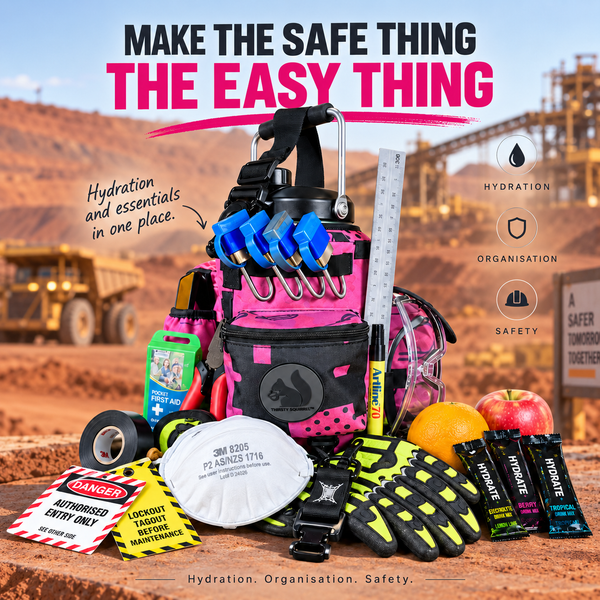
Make the safe thing the easy thing.
Because once you start looking at safety through that lens, some interesting questions appear.
Why are safety glasses sometimes something workers can't wait to take off?
Why do we tell people to hydrate but make carrying enough cold water inconvenient?
Why do we give people cheap little accessories that break and then wonder why they're treated as disposable?
Why does some PPE seem designed primarily around meeting a specification rather than the human being who has to wear it for 12 hours?
Compliance asks:
"Does this meet the requirement?"
We think there's another question worth asking:
"Will somebody actually want to use it?"
Those questions aren't mutually exclusive.
A product should do both.
Maybe good safety design is about removing friction
Imagine if we approached more safety problems this way.
Instead of asking:
How do we make workers comply?
Ask:
Why is the safe behaviour difficult in the first place?
If gloves aren't being worn, don't stop at:
"Wear your gloves."
Ask where the gloves are.
Ask whether they're suitable.
Ask whether they interfere with the task.
Ask whether workers can easily carry them when they're not using them.
If hydration is poor, don't stop at:
"Remember to hydrate."
Ask whether workers can carry enough water.
Ask whether it stays cold.
Ask whether water is readily available where the work is actually happening.
If workers don't want to wear their safety glasses, don't immediately assume attitude is the only problem.
Ask whether they're comfortable.
Ask whether they fog.
Ask whether they fit properly.
And yes...
Ask whether people actually like wearing them.
That's not making safety soft.
That's designing around human beings.
What if we measured safety differently?
Maybe alongside:
How many inspections did we complete?
we should ask:
What did those inspections improve?
Alongside:
How many hazards were reported?
ask:
How many were permanently removed?
Alongside:
How many people completed training?
ask:
What changed afterwards?
Alongside:
Did everyone sign the SWMS?
ask:
Does the SWMS actually describe how the job gets done?
And alongside:
Are workers complying?
perhaps occasionally ask:
Have we made compliance unnecessarily difficult?
That's a much harder conversation.
But it might be a much more valuable one.
Safety should protect people before it protects paperwork
We need compliance.
We need evidence.
We need accountability.
And businesses should absolutely be able to demonstrate that they have fulfilled their WHS duties.
But none of those things should become the finish line.
The finish line is the person doing the work.
Safe Work Australia's national strategy says the goal is to reduce worker fatalities, injuries and illness, and its current 2023–2033 program is still measuring progress against those outcomes.
That's ultimately the scoreboard that matters.
So perhaps the question isn't whether we need compliance.
Of course we do.
The better question is:
Does our compliance activity genuinely make work safer — or does some of it simply make safety easier to prove?
Because the strongest safety system shouldn't only look good during an audit.
It should work when nobody from safety is watching.
It should work at 2am.
It should work when production pressure is on.
It should work when it's 45 degrees.
It should work for the person actually doing the job.
And wherever possible, it should make the safest choice the simplest choice.
That's the kind of safety we're interested in.
Safety shouldn't just be easy to prove.
It should be easy to do.
Thirsty Squirrel PPE Co.
Make the safe thing the easy thing.
Further reading
For anyone who wants to dig deeper into the thinking behind this article, the most current Australian context is Safe Work Australia's Australian Work Health and Safety Strategy 2023–2033 and its March 2026 Best Practice Review consultation findings. The practical regulatory side is covered well in Safe Work Australia's current risk-management guidance and WorkSafe WA's duty to manage WHS risks guidance.

Shop the gear from this guide
Browse the Thirsty Squirrel products mentioned in this article.